Small Fiber Neuropathy Foundation
⏱ 9 min read
A Chronic Pain Population's First Web Platform
Led research on what would serve the SFN community online. Direct patient outreach revealed trust was the single biggest barrier. Research findings directly shaped product strategy: specialist-reviewed content, community first, and feedback-by-design. The result: 718% support group growth and 38% traffic increase within the first month.
Research Approach
Community-Led Research + Specialist Partnerships
Direct outreach to 50+ SFN patients on Reddit surfaced the trust barriers blocking engagement. Partnered with leading SFN neurologists to turn clinical credibility into visible design signals.
Key Insight
Trust was the single biggest barrier. Clinical accuracy alone wasn't enough; patients needed to see that someone had verified the information.
- +718%
- Support group growth in month one (11 to 90 members)
- +38%
- Web traffic growth via SEO
- 340+
- User feedback submissions in 90 days
- ADA
- WCAG 2.1 AA compliant
- My Role
- Lead UX Researcher
- Team
- 1 Product Designer
- 2 Researchers
- Timeline
- 2 Months
- Tools
- Figma
- Miro
- Google Forms
- Business
- Non-Profit
- Healthcare
Context
Small Fiber Neuropathy is a chronic pain disorder that is frequently misdiagnosed and poorly understood, even by specialists. The existing neuropathy foundation website covered too many conditions to go deep on any one of them. Patients with SFN were left to piece together information from academic papers, Reddit threads, and general chronic pain forums. None of those resources were built for them, and none were trustworthy enough to rely on when making decisions about their care.
The Challenge
Research what would serve the SFN community online. Understand what barriers kept patients from finding trustworthy information. Figure out whether information architecture or trust signals were the limiting factor. Do this on a non-profit budget, in two months, without dedicated engineering resources.
The Solution
Direct patient research combined with specialist partnerships that revealed trust was the core unmet need. Research findings shaped product priorities: specialist-reviewed content with visible credibility signals, community as the first interaction, and feedback buttons on every page turning users into an ongoing research panel.
Problem
SFN patients are not casual browsers. They are people managing a serious, often invisible condition. They have frequently been dismissed by doctors, given conflicting information, and left to research on their own. They were not looking for more content to sort through. They needed one trusted resource built specifically around their condition, and one did not exist.
Constraint
What was broken and why
There was no good SFN-specific resource online. The broader neuropathy foundation site covered too many conditions to go deep on any one of them. SFN patients were forced to rely on Reddit threads, academic papers, and general chronic pain forums, none of which were built for them, verified for accuracy, or written in language a non-specialist could understand.
- •No SFN-specific platform existed despite it being a distinct condition with distinct needs
- •General neuropathy resources did not address SFN symptoms, diagnosis pathways, or treatment options
- •Medical information was scattered, inconsistent, and impossible to verify
- •Patients felt isolated with no peer community or shared support structure
- •No existing resource met ADA compliance standards or accounted for the fatigue of its users
Research Approach
I ran research in two phases: direct patient outreach to surface unmet needs in their own words, and specialist partnerships to understand how to translate research findings into trustworthy content. Both were non-negotiable for a healthcare product, and especially for one serving a community that had been let down by health information online before.
- 1
Discover
Reddit outreach and patient interviews to surface unmet needs
- 2
Define
Trust gaps, information hierarchy, and community requirements
- 3
Synthesize
Map patient insights to product priorities and content strategy
- 4
Validate
Specialist review for clinical accuracy and patient feedback rounds
- 5
Measure
Deploy with feedback collection on every information page

Research Insight 1: Trust Was the Core Barrier
I went directly to the main SFN subreddit for candid feedback on the existing broader neuropathy foundation website, recruiting research participants from a community that already trusted each other. What was missing, what was frustrating, and what patients actually needed that no resource was providing.
Rather than assume what was missing, I went to where patients already gathered and asked them directly. Going to an existing community gives you unfiltered, honest responses from people with real stakes in the answer, and it costs nothing but the time it takes to be respectful when you show up.
Key Insight
What I discovered
Trust was the single biggest barrier. Patients wanted reputable sources cited for every medical claim and were deeply skeptical of health information online, often because they had been given wrong information before. Beyond accuracy, the most urgent ask was for community. SFN is a long-term condition and people needed to connect with others going through the same experience, not just read articles about their symptoms.
Research Insight 2: Visible Credibility Signals Were Essential
From the research findings, I identified a critical insight: visible expert endorsement would be the key to shifting how patients felt about the platform. I worked with the team to recruit leading SFN neurologists to review all medical content before launch and designed their bylines into the page itself, turning expert review into a visible credibility signal users could see at a glance.
Given how strongly patients expressed the need for verification and felt about accuracy in the research interviews, I needed to make credibility visible and verifiable. A disclaimer at the bottom of a page is easy to ignore. A named specialist byline at the top of every article is not, and research showed it would address the core trust barrier.
Research Insights Applied
Every product decision was grounded in a specific research finding. The goal was a platform that felt calm, credible, and easy to navigate for someone who is already exhausted, one that earned trust before a user had read a single sentence, because research had shown that was the barrier that mattered most.
Color Choice: Research-Backed Trust Signals
I researched color psychology in healthcare contexts and chose a dark purple-blue palette backed by peer-reviewed research [1][2][3]. The range communicates calm, credibility, and seriousness without feeling cold or clinical. For an audience that has been misled before, color is not cosmetic, it is the first signal of whether a site is worth trusting. This choice was research-informed rather than aesthetic.
Information Architecture: Immediacy as Research Insight
Research revealed that several users described moments of crisis and isolation. Links to mutual aid resources were placed prominently on the homepage so users in urgent situations could find help without navigating through content sections first. This was a direct response to a pattern in user interviews: people come to SFN information platforms in moments of stress, not curiosity. Immediate help had to come before navigation.
Feedback Buttons: Continuous Research Channel
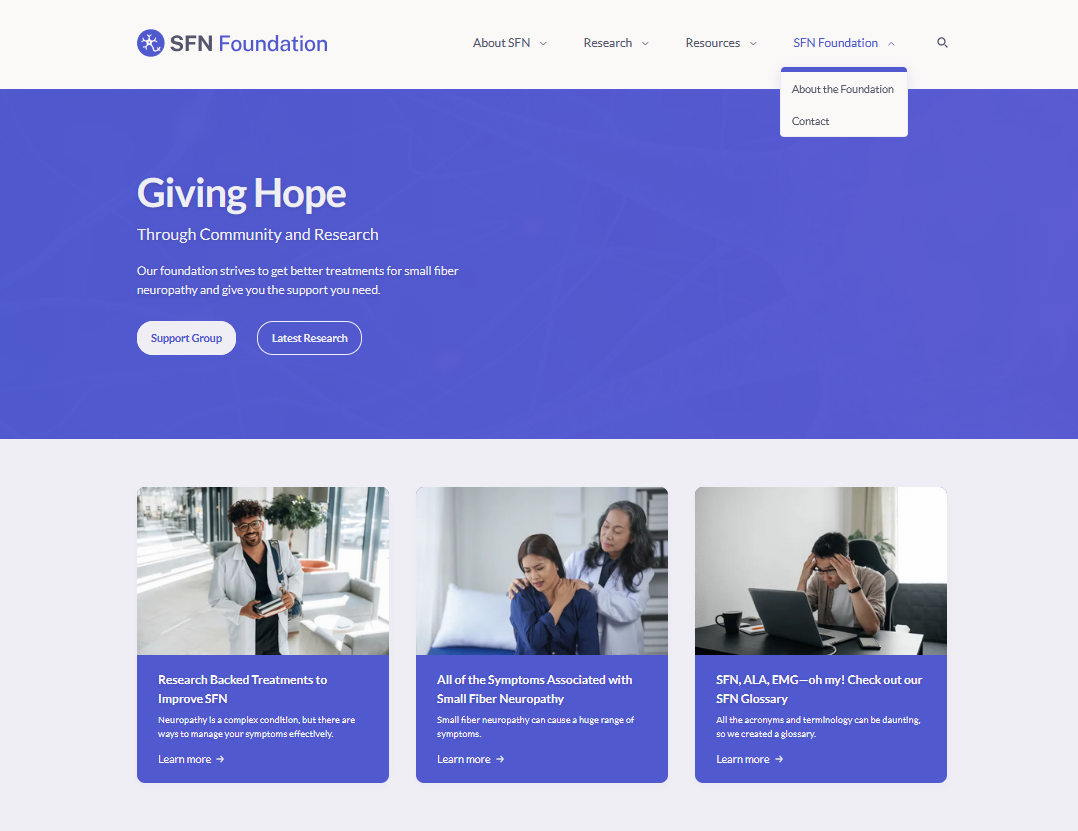
I added a visible feedback button at the bottom of every information page. Within a non-profit budget, this was the most scalable research method available, and it worked. 340+ submissions in 90 days turned passive readers into an ongoing research panel, no recruiting budget required, and gave the foundation a permanent feedback loop after I rolled off the project. What looked like a feature was actually continuous research.
Dual-Trust Model: Research Findings Into Product Design
Research interviews revealed two distinct trust mechanisms in the patient community: clinical credibility (expert bylines prove accuracy) and peer validation (other patients prove it's real and survivable). Patient testimonials were featured alongside specialist-reviewed content deliberately to address both. Clinical credibility from experts tells users the information is accurate. Peer testimonials tell them someone else has lived through the same experience. Both are trust signals, but they serve different emotional needs that research had uncovered.
Search UX: Translating Patient Language Barriers
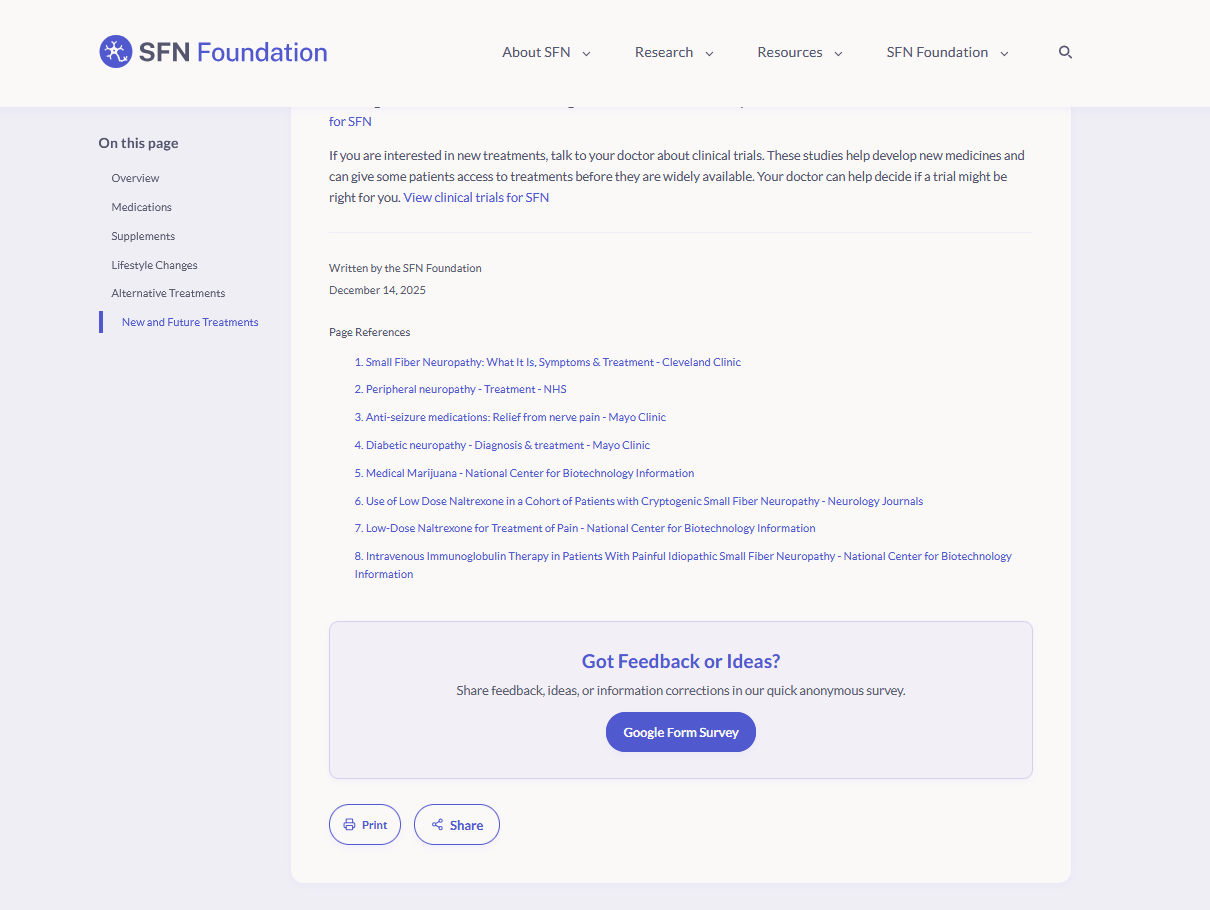
Research revealed that SFN patients often describe their symptoms in lay terms, not clinical language. I designed a search filtering UI that ranks results by relevance and accepts lay terminology, surfacing the most useful content first without requiring users to know the exact clinical terminology for what they are experiencing. This was a direct response to research findings: a search experience that meets patients in their own language reduces friction and prevents the dead ends that drive users off health platforms entirely.
Impact
The platform launched in two months and immediately became the go-to resource for the SFN community. Web traffic climbed 38% from the content architecture informed by research. The support group grew 718% in month one, from 11 to 90 members. The feedback system collected 340+ submissions in the first 90 days, giving the foundation a direct line to what patients needed next, long after I rolled off. Growth that steep comes from research being right about what people actually needed.
Key Insight
The number that matters most
Going from 11 to 90 support group members in a single month is not a vanity metric. It means people found what they were looking for and trusted it enough to bring others with them. That kind of growth only happens when a product is genuinely useful to the people it was built for. Research shaped every decision that led to that outcome.
Reflection
This project reinforced something I now apply to every engagement: research into what someone needs is the foundation for whether they will actually use what you build. The users were not casual visitors. They were people managing a serious chronic condition, often frustrated, often skeptical, and looking for something they could actually rely on. Every shortcut I might have taken on a typical project felt unacceptable here, and the work was better for it because research set the bar.
What I Would Do Differently
I would have invested more time in video interviews with people actively living with SFN. Survey responses and Reddit comments gave useful directional signal, but watching someone describe their experience in person builds a different kind of empathy than reading a text response. That understanding would have sharpened several decisions earlier. The biggest insight I'd carry forward: for health platforms, trust is not a feature, it is the foundation. Every design choice either builds or undermines it. Specialist bylines, cited sources, peer validation, plain language, immediacy in moments of crisis: these were not aesthetics. They were research findings translated into product decisions. And a non-profit budget forced feedback-by-design, which produced richer ongoing insight than any one-time research sprint.
“I need reputable sources. I need to know someone checked this. I've been given bad information too many times.”
Sources
Research and references cited throughout this case study.
- 1.Leveraging the Psychology of Color in UX Design for Health and Wellness Apps, UXmatters, 2024
- 2.Color and Psychological Functioning: A Review of Theoretical and Empirical Work, Elliot & Maier, Frontiers in Psychology, 2015 (via NIH/PubMed Central)
- 3.Trustworthy Blue or Untrustworthy Red: The Influence of Colors on Trust, Su, Cui & Walsh, Journal of Marketing Theory and Practice, 2019